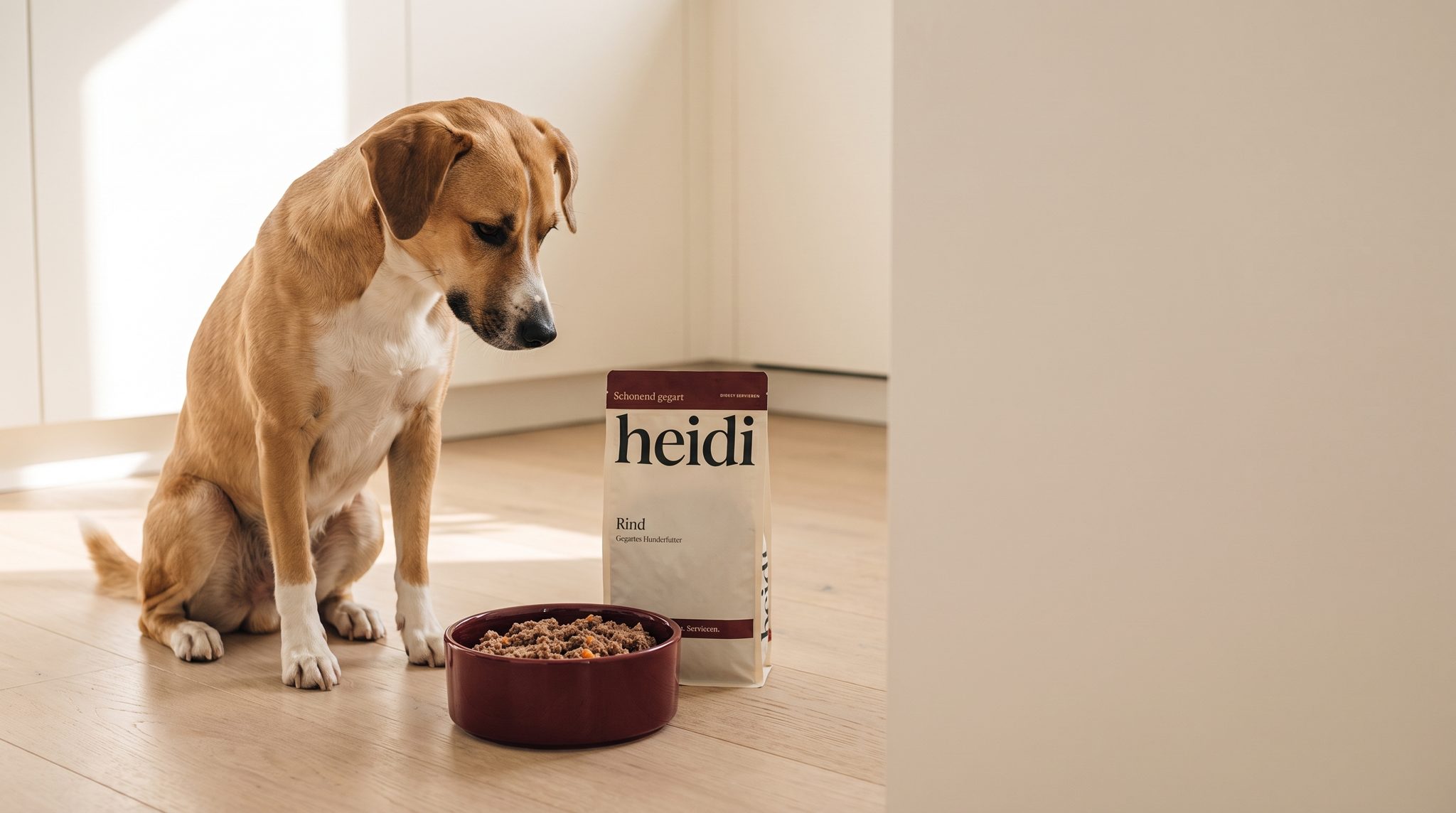
Product portfolio
and line-up
Two questions, answered with what we can check:
why this market now, and why us.
They already try to fix it.
It just doesn't visibly work.
- 58.6 per cent of owners reported a health problem in the last twelve months. Digestion leads at 38.9 per cent.
- 77.8 per cent already give supplements. Only 64.3 per cent of them are satisfied.
- The single biggest reason for dissatisfaction: no visible effect.
Own survey, n = 162, August 2026, 93.8 per cent living in Germany.
The market is not growing. The money inside it is moving.
Change 2024 against 2023, per cent. German pet market, total 7.0 bn EUR. Every bar is labelled, so the direction is readable without colour.
- Owners cut back on gear and kept spending on the bowl. The trade association said so in 2024 and the segment numbers agree.
- There is no category growth to ride. There is a shift: from shops to online, from mass to premium, from accessories to health.
Source: IVH/ZZF, "Der Deutsche Heimtiermarkt 2024", press release of 16 April 2025.
Prevention turned into arithmetic.
What the vet now costs
Price change from the German vet fee reform of November 2022, per cent.
- Cruciate ligament surgery 1,500 to 4,000 EUR. Dental work with extractions 1,000 to 1,800 EUR. Gastric torsion up to 6,000 EUR.
And owners already pay to avoid it
Sources: GOT reform of November 2022 (Bundesrat rationale, Allianz guide); published vet price lists 2025/26; FellAkte market analysis 2025; hello-safe barometer 2025; Uelzener survey 2024 (n = 1,100).
Supplements alone have a ceiling. The bowl is where the money is.
- A supplement-only brand is competing for a slice of a small pot. The arithmetic runs out well before the business gets interesting.
- So the order matters more than the category. Start where trying costs nothing, then earn the bowl.
Sources: Market Data Forecast 2025 and IndexBox 2025 (analyst estimates, not audited); IVH/ZZF 2024. Competitor ranges read from their live product feeds on 17 September 2026.
Two halves of the shelf, each with a different leader.
| Half | Who leads it today | What is moving |
|---|---|---|
| Supplements 110–160 m EUR |
Mammaly is the clear DACH leader in soft chews. AniForte, ReaVET, ivvi and Liebs follow. | Mammaly changed managing director in July 2025. AniForte's owner TNC is consolidating hard against a 650 m EUR target. |
| Food 1.8 bn EUR |
No single leader. Volume sits with retailer brands (Fressnapf, zooplus) and the old manufacturers. Premium DTC is split between Pets Deli, Terra Canis, Dog's Love and HelloBello. | The shelf-stable cooked segment is being built right now by Marleybones, Fred & Felia and Pure Bob. None of them is more than a few years old here. |
Company signals from public filings and press, own benchmark research July 2026, updated 17 September 2026. The window is a judgement, not a measurement.
The question they ask before they buy.
We ran two product concepts past 162 owners and coded every open answer by hand. On both concepts the same question came back more often than any other.
- Transparency is not the biggest pain in this market. Most owners say they are happy with the food they buy. It is the biggest unanswered question at the moment of purchase, which is a different and more useful thing.
- So it is not our headline. It is our answer to the headline.
Own survey, August 2026. 94 non-empty open answers on the food concept, 65 on the sauce concept, manually coded.
We read the labels. Everyone is half honest.
| Brand | Amount per ingredient | Origin of the ingredients |
|---|---|---|
| Rigby US, lickable pouch |
No. Three or four ingredients, no percentages. Crude fibre max 0.62 per cent, published under a "supports digestion" claim. | Yes, in full. Marin Sun Farms, Point Reyes, since 1999. Mary's Organic Chicken, since 1954. Stahlbush Island Farms, Oregon, since 1985. MSC salmon from Alaska. A paragraph on each, saying why they picked them. |
| Marleybones UK/DE, cooked food |
Yes, in full. Beef 60%, carrots 6.5%, sweet potato 4%, quinoa 3%, broccoli 1.3%, rosemary 0.8%. Additives in mg and IU. | Nothing. No farm, no supplier, no country of origin for any ingredient, on any page of the site. |
| Mammaly DE, supplement leader |
Yes, in full. Carrot 7%, pumpkin seed 3.8%, psyllium 2%, chicory 1.4%. Even the strain: Bacillus velezensis 4b1820, 3.4 × 10¹⁰ CFU per kg. | Weak. "Made in Germany" plus branded raw materials. That names the ingredient supplier, not where the raw material grew. |
| Fred & Felia DE, own factory |
Yes. Percentages on the functional ingredients, analytical constituents alongside. | Weak. "Made in Germany". Place of cooking, not origin of the meat. |
| Heidi | Both. | Both. |
Checked on 17 September 2026 by retrieving the live product pages and Shopify product feeds. Pure Bob loads its ingredient tab with JavaScript and could not be verified this way; it stays open.
One standard: name, amount, origin. On every ingredient.
The amount, in a unit you can use
A percentage for every ingredient, actives in milligrams or colony forming units, stated per serving rather than per kilo. Mammaly publishes CFU per kilo. Nobody can divide that in a supermarket aisle.
The origin, by name
The farm or the fishery, where it is, how long it has been there, and a line on why we chose it over the cheaper one.
Including the awkward ones
Preservatives and anything else a brand would rather hide get declared the same way. A standard you break once is not a standard.
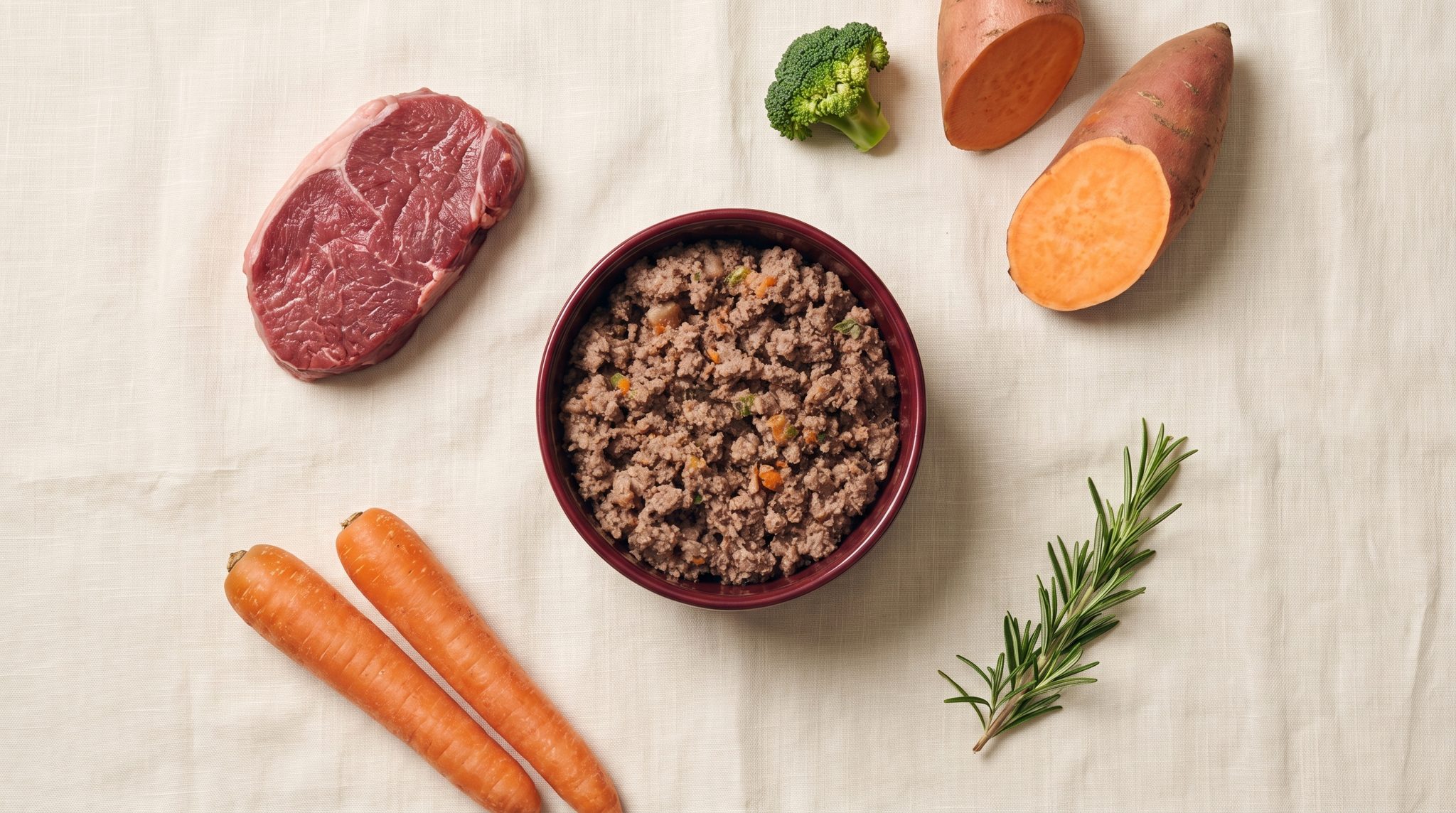
Every ingredient shown separately is the point, not a styling choice. It is only possible on a recipe short enough to trace.
"What if Mammaly just adds it?" Then they do.
What this standard is
- A wedge, not a moat. It gets us noticed and it gives a reason to try. It stops nobody. Any brand with a budget can print more numbers.
- One real friction, and only friction. Mammaly's product is processed powders built on bought-in branded raw materials. Farm-level origin means rebuilding procurement for something that does not come from a farm. That costs them time. It is not a wall.
- The moat, if we get one, is not the label. It is an audience that belongs to us and a daily habit in the bowl. Anything else would be a story.
What it costs us
- Naming farms binds our buying. It has to survive a price rise, and it removes the option of switching quietly. That is a constraint on us, not only on them.
- Through a co-packer who buys the raw material himself, we may not even know the farm. Whether he will let us name it is an open question in the supplier talks now.
- It only works on a short recipe. Four ingredients can be traced. Fifteen plus a vitamin premix cannot.
What we measured ourselves, including what failed.
Two concepts tested, both weak
- Purchase intent below 4 out of 10 on both. 34.6 per cent said they would not buy at all.
- 64.8 per cent prefer a one-off purchase over a subscription.
- Smoke test, 3 to 13 September: 423 EUR spend, 567 landing page views, 63 add to cart, 12 checkouts, 3 Shopify orders. Meta counted four purchases against three real orders and we have not explained the gap.
What we take from it
- Both formats asked people to replace a food that already works. In the open answers that was the most common objection by far.
- Nobody changes their dog's diet on the strength of an advert. So the failure was the size of the ask, not the category.
Two products, one standard, in this order.
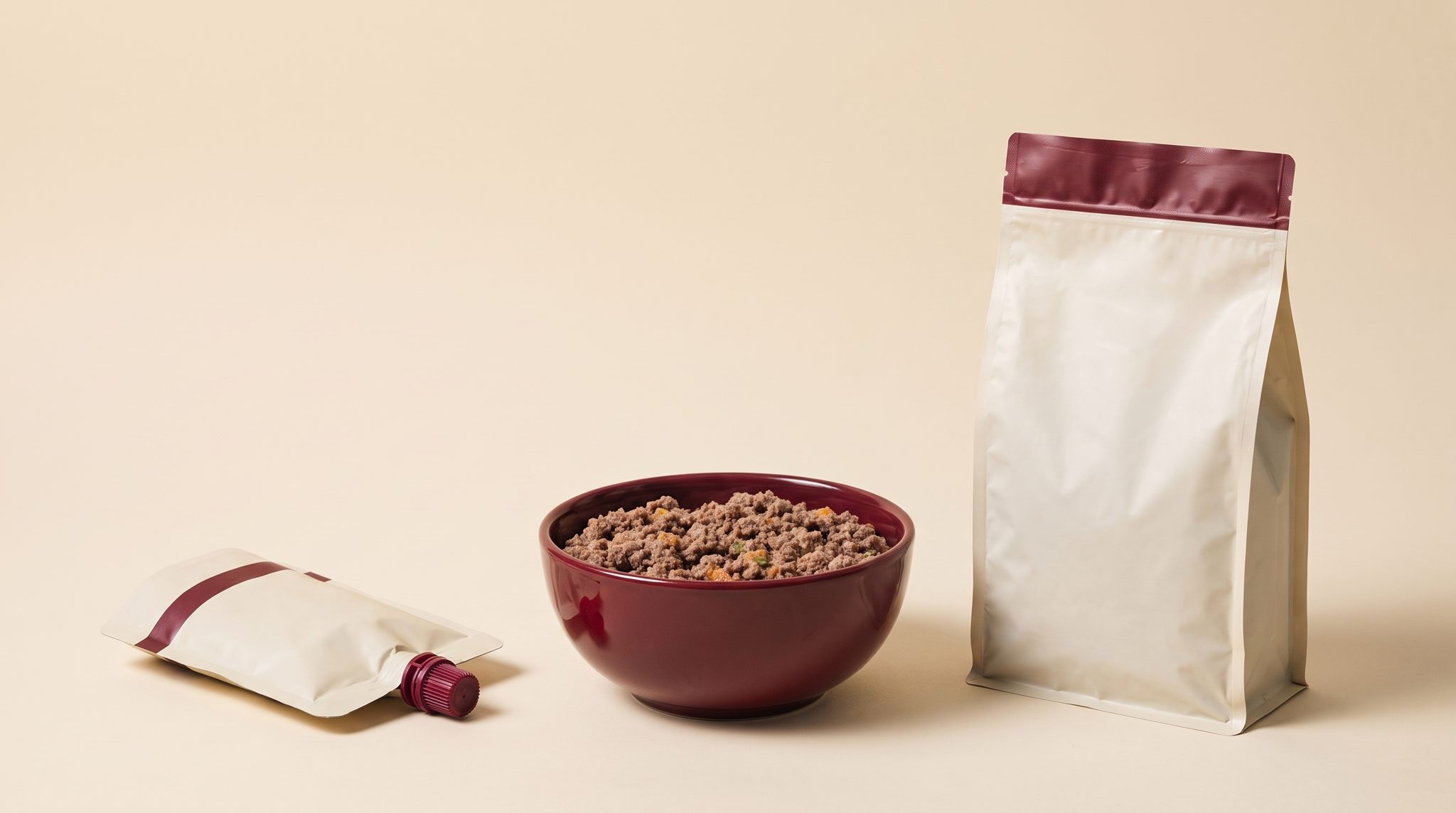
Costs nothing to try, because it goes on top of whatever they feed today. Short enough that we can name every farm on it.
Carries the revenue and the subscription. Sold to people who already bought the standard once and believed it.
An honest treat, built to be used every day.
What it is
- A lickable pouch. Shelf stable, no freezer, no cold chain.
- A short recipe. Every ingredient with its amount and its named farm.
- Squeezed over the bowl, spread on a lick mat, used as a reward, or wrapped round a tablet.
- Calories per serving printed as a number, not implied by a claim.
Who it replaces
- Not a brand. A habit: liver sausage, cream cheese from the tube, scraps from the table. Habits do not fight back and they have no marketing budget.
How it is priced
- Discount by quantity, not by contract length. Permanent, not a first-order trick that collapses on delivery two.
- Shipping visible from the first order. Rigby charges from the second and it is the obvious reason people cancel.
- One consumption story, told identically everywhere. Rigby currently publishes two that differ by a factor of five.
Gently cooked food in a pouch. The revenue product.
What it is
- Cooked, shelf stable, in a pouch. Four varieties: beef, chicken, lamb, salmon.
- No freezing, no thawing, no cold chain, which is what makes the economics work without a factory.
- Carries the subscription and the order value. The pouch carries the relationship.
Where it stands
- Supplier indication so far: 1.80 EUR per 300 g plus tooling, eight to nine months lead time.
- Sold into a base that has bought from us once, not into cold traffic.
Supplier figures from the manufacturer conversation of 9 September 2026. An indication, not a quote.
Sequence, not breadth.
Standard written down. Recipe and named sourcing for product one. A test with a working checkout and real payment.
Product one launches. Subscription with quantity tiers. Amazon from month three.
Food pilot, cross-sold into the existing base first. Retail conversation opened with cohort data, not a deck.
Food scales. Further need states and a retail format, but only once the first two work.
Four things we have to prove.
| Gate | What counts as passed | Where it actually stands |
|---|---|---|
| Sourcing | At least two ingredients traced to a named farm that agrees in writing to be named on the pack. Without this the positioning is a slogan. | Not started |
| Checkout | One real purchase completed end to end, including PayPal. | Unresolved Campaign closed 13 Sept. Four Meta purchase events against three Shopify orders, cause not diagnosed. PayPal never tested in practice. |
| Unit economics | Calories per serving, euro per day at or below 1.00, positive contribution after shipping. Our survey puts the bulk of willingness to pay at or below one euro a day. | Blocked on recipe |
| Demand | A cohort with a measured acquisition cost and a second-order rate. Not clicks, not add to cart. | Tested twice, failed twice Sauce and mix-with-water. Both weak. Neither reached a second order, so we have no retention signal at all. |
Where the numbers come from.
- Market size and segments: IVH/ZZF, "Der Deutsche Heimtiermarkt 2024", 16 April 2025.
- Wider pet economy: Ohr study 2025, University of Göttingen, published 21 January 2026.
- Vet fees: GOT reform of November 2022, Bundesrat rationale and Allianz guide. Procedure costs from published vet price lists 2025/26.
- Insurance: FellAkte market analysis 2025, hello-safe barometer 2025, Uelzener survey 2024 (n = 1,100).
- Supplement market: Market Data Forecast 2025, IndexBox 2025. Analyst estimates, not audited.
- Label comparison: live product pages and Shopify product feeds of rigbypets.com, marleybones.com, mammaly.de and fredfelia.com, retrieved 17 September 2026.
- Own survey: n = 162, August 2026, recruited through Dogorama.
- Smoke test: Meta Ads and Shopify data, 3 to 13 September 2026, closed and documented.
- Supplier indication: manufacturer conversation of 9 September 2026.
- Competitive window: own benchmark research July 2026, updated 17 September. Judgement, not measurement.